Access specifiers or Access modifiers in Python Programming
Access Modifiers: Access specifiers or access modifiers in python programming are used to limit the access of class variables and class methods outside of class while implementing the concepts of inheritance. This can be achieved by: Public, Private and Protected keyword.
We can easily inherit the properties or behaviour of any class using the concept of inheritance. But some classes also holds the data (class variables and class methods) that we don’t want other classes to inherit. So, to prevent that data we used access specifiers in python.
Note: Access modifiers in python are very helpful when we are using the concepts of inheritance. We can also apply the concept of access modifiers to class methods.
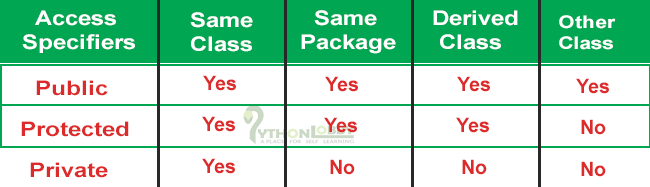
Believe me, we are going to keep it very simple: We are done with the definition of access modifiers in python. Next, we will see the syntax and then types of access specifiers (public, private and protected) in Python. Later a detailed example of each type of access specifiers.
Syntax example :
#defining class Student
class Student:
    #constructor is defined
    def __init__(self, name, age, salary):
        self.age = age             # public Attribute
        self._name = name          # protected Attribute
        self.__salary = salary     # private Attribute

    def _funName(self):            # protected method
        pass

    def __funName(self):           # private method
        pass

# object creation
obj = Student("pythonlobby",21,45000)

There are three types of access specifiers or access modifiers
- 1). Public access modifier
- 2). Private access modifier
- 3). Protected access modifier
Public Access Modifier in Python
All the variables and methods (member functions) in python are by default public. Any instance variable in a class followed by the ‘self’ keyword ie. self.var_name are public accessed.
syntax:
# Syntax_public_access_modifiers

# defining class Student
class Student:
    # constructor is defined
    def __init__(self, age, name):
        self.age = age             # public Attribute
        self.name = name           # public Attribute

# object creation
obj = Student(21,"pythonlobby")
print(obj.age)
print(obj.name)

Let’s see some examples of access specifiers to understand the concepts better.
Example 1: Example of elaborating the use of Public Access Modifiers.
#Example_of_public_access_modifiers

class Student:
	def __init__(self,age):
	self.age = age

class Subject(Student):
	pass

obj = Student(21)
obj1 = Subject()
print(obj1.age)
Private Access Modifier
Private members of a class (variables or methods) are those members which are only accessible inside the class. We cannot use private members outside of class.
It is also not possible to inherit the private members of any class (parent class) to derived class (child class). Any instance variable in a class followed by self keyword and the variable name starting with double underscore ie. self.__varName are the private accessed member of a class.
Syntax:
# Private_access_modifiers
class Student:
    def __init__(self, age, name):
        self.__age = age

        def __funName(self):
            self.y = 34
            print(self.y)

class Subject(Student):
    pass

obj = Student(21,"pythonlobby")
obj1 = Subject

# calling by object reference of class Student
print(obj.__age)
print(obj.__funName())

# calling by object reference of class Subject
print(obj1.__age)
print(obj1.__funName())
Example 2:
# Example_of_using_private_access_modifiers
class Student:
    def __init__(self):
        self.name = "Adams Boi"  # Public
        self.__age = 39          # Private

class Subject(Student):
    pass

# object creation
obj = Student()
obj1 = Subject()

# calling using object ref. of Student class
print(obj.name)  # No Error
print(obj1.name) # No Error

# calling using object ref. of Subject class
print(obj.__age)  # Error
print(obj1.__age)  # Error
Protected Access Modifier
Protected variables or we can say protected members of a class are restricted to be used only by the member functions and class members of the same class. And also it can be accessed or inherited by its derived class ( child class ). We can modify the values of protected variables of a class. The syntax we follow to make any variable protected is to write variable name followed by a single underscore (_) ie. _varName.
- Note: We can access protected members of class outside of class even we can modify its value also. Now the doubt that arises is, public access modifiers follow the same except its syntax. Actually, protected access modifiers are designed so that responsible programmer would identify by their name convention and do the required operation only on that protected class members or class methods.
Syntax and Example 3:
#Syntax_protected_access_modifiers
class Student:
    def __init__(self):
        self._name = "PythonLobby.com"

    def _funName(self):
        return "Method Here"

class Subject(Student):
    pass

obj = Student()
obj1 = Subject()

# calling by obj. ref. of Student class
print(obj._name)      # PythonLobby.com
print(obj._funName())     # Method Here
# calling by obj. ref. of Subject class
print(obj1._name)     # PythonLobby.com
print(obj1._funName())    # Method Here